




2025 Innu Nation Uinipekᵘ Expedition: Full Recap

For the third summer in a row, Innu Nation, with support from the Students on Ice Foundation (SOI), led the Innu Uinipekᵘ Expedition, a two-leg journey through the lands and waters of Nitassinan. This unique expedition brought together Innu leaders, Guardians, Elders, youth interns, scientists, researchers, and educators for a powerful experience rooted in Innu knowledge and strengthened through collaborative science and storytelling. Guided by Innu priorities, the robust scientific data collected on the expedition every year includes over 150 individual samples or surveys within Innu waters, consisting primarily of underwater video and scuba dive surveys, physical oceanography, environmental DNA, and water property measurements. This research supports Innu Nation’s marine monitoring and decision-making about Innu lands and waters. The expedition offers youth the chance to deepen their connection to land and culture while also building practical skills in coastal monitoring, ocean science, archaeology, and media documentation.
For Marie Soleil Penashue, Outreach Coordinator with Innu Parks, the expedition provides youth the opportunity “to be together, to feel grounded on the land, and think about how their Innu ancestors lived. How they survived, how they hunted, the meanings of the artifacts, and to think about their future career opportunities.”
“It really got me thinking about my future. I’m really considering something out HERE,” said Sheshatshiu Youth Intern, Quentin Penashue.

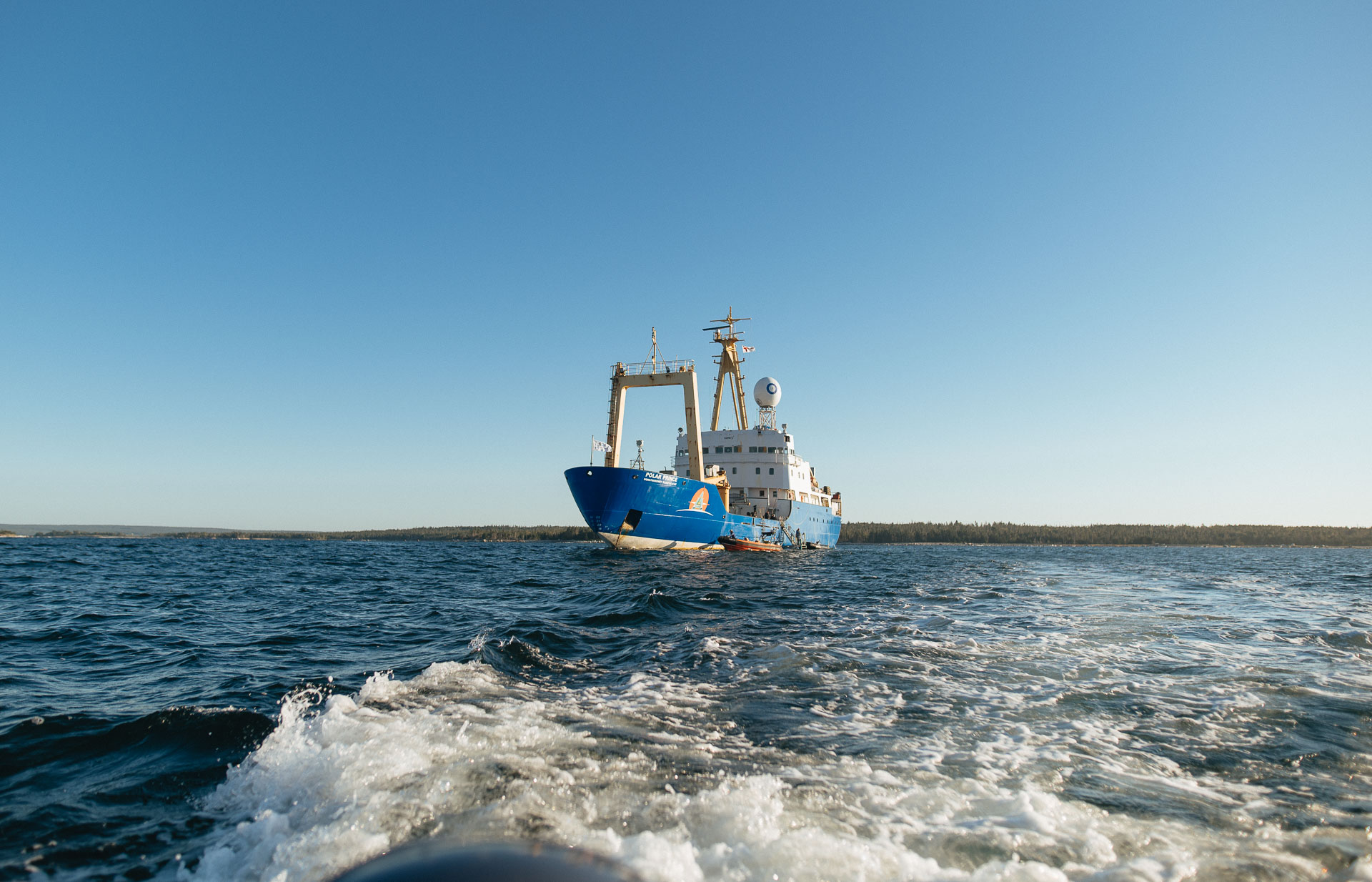
SOI supported this year’s expedition once again with vessel and logistical coordination, helping design and facilitate educational activities, and helping to document the journey through photos and video. However, what truly defines the project is that Innu Nation leads it. The guidance of Innu Guardians, the knowledge of Elders, and the direction of community leadership shaped every element of the expedition, from the sites visited to the stories shared. Youth joined the expedition as interns aboard the vessel, where they participated in structured learning streams and supported research activities across both legs of the journey.
Each leg covered a distinct region of Innu territory. Leg One explored the southern coastline in the traditional lands of the Sheshatshiu Innu, beginning at Amishku-shipiss (Beaver Brook – Swallow Harbour) within Akamiu-Uapishku -KakKasuak-Mealy Mountains National Park Reserve. The team travelled north through Hamilton Inlet, circumnavigated the Gannet Islands Seabird Ecological Reserve, and concluded with a community open house in Sheshatshiu. Leg Two shifted north to the Natuashish Marine Zone, within the traditional territory of the Mushuau Innu. This leg included stops at Castle Island, Solomon Islands, and other culturally and ecologically significant sites. Across both legs, youth from both Sheshatshiu and Natuashish participated, building relationships across communities and sharing the experience of being on the land and sea together.

“We go on the land to experience the freedom and the peace. When you’re out on the land, your dreams become very clear,” said Mark Nui, Senior Land Claims Negotiator, Innu Nation, Natuashish.

A key element of the expedition was its educational model, which invited youth to take part in one of four learning streams. In the Ocean Science stream, interns worked with researchers and divers to collect water samples, analyze biodiversity, and observe ecosystems ranging from seabird colonies to soft coral gardens. The Underwater Technology stream trained youth to employ tools of marine science that gather important marine information. Remotely operated vehicles (ROVs) and drop cameras were used to survey seafloor environments, and an Autonomous Surface Vehicle (ASV) was used to map the seafloor. The Land and Coastal Skills stream focused on Innu knowledge systems, with Innu Parks Guardians and research partners teaching archaeological surveying and traditional land skills, including navigation, Innu land-use history, fire and shelter building, and traditional harvesting and food preparation techniques. Finally, the Media and Storytelling stream saw interns interview Elders and other youth participants, document fieldwork, and capture the essence of the expedition through photography and video.

“I’ve learned so much between the Guardians, the scientists, and the archaeologists,” said Natuashish Youth Intern, Emma White.
One of the key highlights every year is the deployment of ocean current drifters, named in Innu-aimun, which provide invaluable real-time data on ocean currents. This initiative not only advances scientific understanding but also strengthens the connection between Innu Nation and global ocean research networks. It’s also a lot of fun! This project is in collaboration with the Department of Fisheries and Oceans and is contributing to a worldwide network of drifter research, fostering both local and global scientific engagement.

As with previous years, the 2025 Uinipekᵘ Expedition is a living example of what can happen when Indigenous leadership, community-based learning, and meaningful cross-cultural collaboration come together. It demonstrates how science and stewardship can be grounded in culture, and how learning on the land can be both rigorous and deeply personal. The data collected on expedition every year is owned and used by Innu Nation to inform important marine and coastal management decisions and land claim negotiations. We’re honoured to continue supporting this powerful initiative, and we look forward to what comes next as Innu youth continue to grow their roles in protecting and celebrating Nitassinan.
To learn more about the expedition visit: www.uinipekuexpedition.ca

Watch the full recaps of legs 1 and 2 here: