



2026 UNESCO World Glaciers and Water Day Recap
In our work at SOI to inspire and empower the next generation of leaders to foster a healthy, sustainable world, the themes of this year’s World Day for Glaciers and World Water Day—conservation and equality—are keenly aligned. That’s why I was honoured to be invited to speak on three different panels at UNESCO’s headquarters in Paris, from March 18 to 19, 2026, which closed the International Year of Glaciers’ Preservation 2025 and marked the new Decade of Action for Cryospheric Sciences.

I am proud to have helped bridge the gap between high-level scientific discussions and the lived realities of the Arctic, offering a human perspective and emphasizing that for us Inuit, ice is not just a data point, but the foundation of life. The panels I joined included:
- Cryosphere loss and its consequences for Water resources on March 18;
- Indigenous and youth-led action for glaciers and mountains on March 19; and
- Science to societies: Ethical and action-oriented adaptation to cryospheric loss on March 19.
Throughout these panel discussions, we explored the effects of glacier retreat and its implications for water security, ecosystems, and livelihoods. We discussed glaciers not just as a scientific or environmental issue, but as human-centred issues, especially for Indigenous communities who consider them sacred landscapes, sources of life-giving water, and symbols of identity. We agreed that Elders and the knowledge systems of local communities, who are the custodians and problem solvers in these Northern ecosystems, are crucial to discussions on climate resilience and adaptation. And we emphasized the importance of bringing together Indigenous knowledge, youth leadership, and science to respond to the challenges facing our cryosphere.

During the Indigenous and Indigenous Youth-led action for glaciers and mountains panel, I discussed Students on Ice Foundation’s work to engage Indigenous youth through our polar expeditions, Blue Futures Pathways’ workforce development initiatives, and our alumni programs like the Arctic Policy Cohort and our new Saavittut (“taking off from shore” in Inuktitut) Inuit Cultural Land Camp that we’re launching later this summer.
Moderated by Sara Manuelli of the Mountain Partnership Secretariat, we explored how Indigenous peoples’ knowledge systems, intergenerational exchange, cultural perspectives, and scientific understanding can work together to support more inclusive policies and approaches to glacier preservation.
I made sure to emphasize the cultural and practical significance of siku (ice) in Inuit communities—serving as critical “infrastructure” that supports our culture, livelihood, food security, and safety. Ice is a bridge for travel that connects communities, a platform for hunting, and a central component of our identity. The sinaaq, or floe edge (where the ice meets the open sea), is especially important as it is where life happens.

Traditional stories connected to the land and water—like those told by Inuit Elders on SOI expeditions—are a way of learning and understanding in Inuit culture. Because ice plays such a central role in traditional storytelling, it was important to me to share the stories I heard while growing up. I told the story of Nuliajuk (aka Sedna), the powerful and protective creator and guardian of all marine life, whose severed fingers turned into all the living things in the sea that our people rely on. We give thanks to Nuliajuk whenever we hunt.
I also told the audience the story of the Qalupalik, a cautionary tale told to protect children from the extreme dangers of the Arctic environment, such as thin ice, treacherous water, and freezing temperatures. The Qalupalik, a woman-like sea creature with green, slimy skin, long hair, and very long fingernails, lurks under the ice, waiting for disobedient children, and makes a humming or tapping sound on the ice to entice them towards the edge. Once close enough, she steals these disobedient children and carries them away in her amauti.

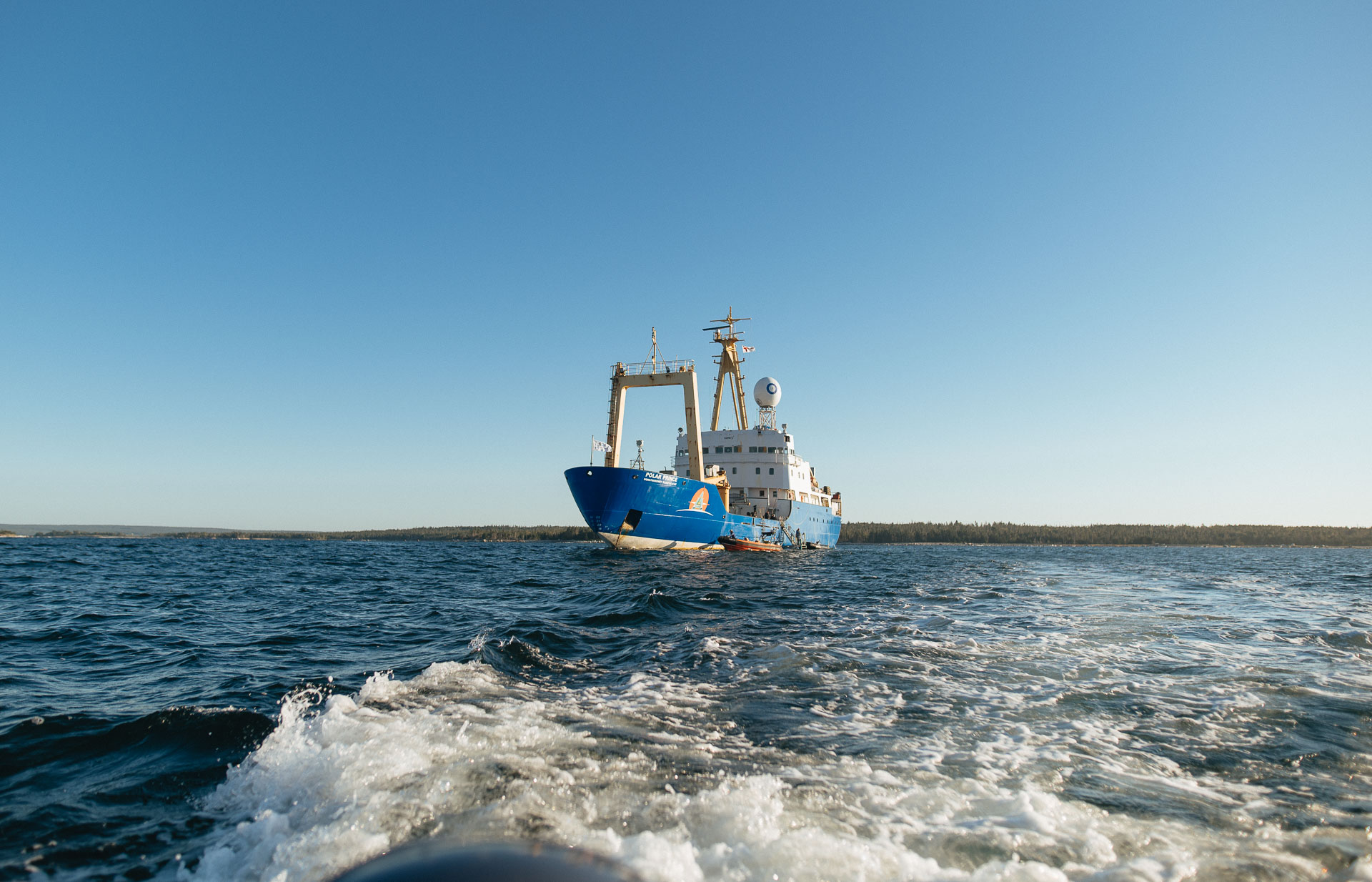
I spoke about the rapid and noticeable decline of glaciers across Nunavut, my home, which is home to some of the world’s most beautiful and important glacier systems. Over the 25 years Students on Ice has been guiding youth in the Arctic, the Devon Ice Cap (one of the largest in the Canadian Arctic) has seen significant ice loss. I explained how I’ve visited Croker Bay on Devon Island’s southern coast several times over the years. When I first landed there, the glacier extended so far into the bay that we could get onto it from the ship. But by 2019, the ice had receded so much that we had to shuttle people by zodiac to shore and hike 5km to reach it. Indigenous youth participants continue to tell us the ice doesn’t come in anymore and is altogether disappearing—a common refrain across the North.
For Inuit communities like mine in Pangnirtung, the rapid change in the Arctic, which is warming about four times faster than the global average, is a direct, lived crisis. The ice is essential, and it’s visibly changing within a single lifetime.
That’s why the growing leadership and influence of young leaders from the North in raising awareness, mobilizing communities, and advocating for stronger action in policy frameworks is more important than ever.

On the final day, I was invited to perform throat singing at a Global Water Ceremony organized by Glacier Nation. I joined Marcela Fernandez, an environmental activist and founder of Cumbres Blancas (“white peaks”) in Colombia, Glacier Nation’s Estefanía Angel, Shari Hamelijnck Ospina of treebytree, and a former White House correspondent and author Emiliana Molina Fajardo. During the ceremony, Marcela recognized that the Inuit language has more than 50 words to describe “glacier” and “snow,” such is the importance of ice in our culture.
In a touching conclusion, the women combined water from across the world—from waterfalls, glaciers, rivers, streams, and oceans—into a vessel to remind us that, like us humans, all water is connected and essential to life on Earth.