
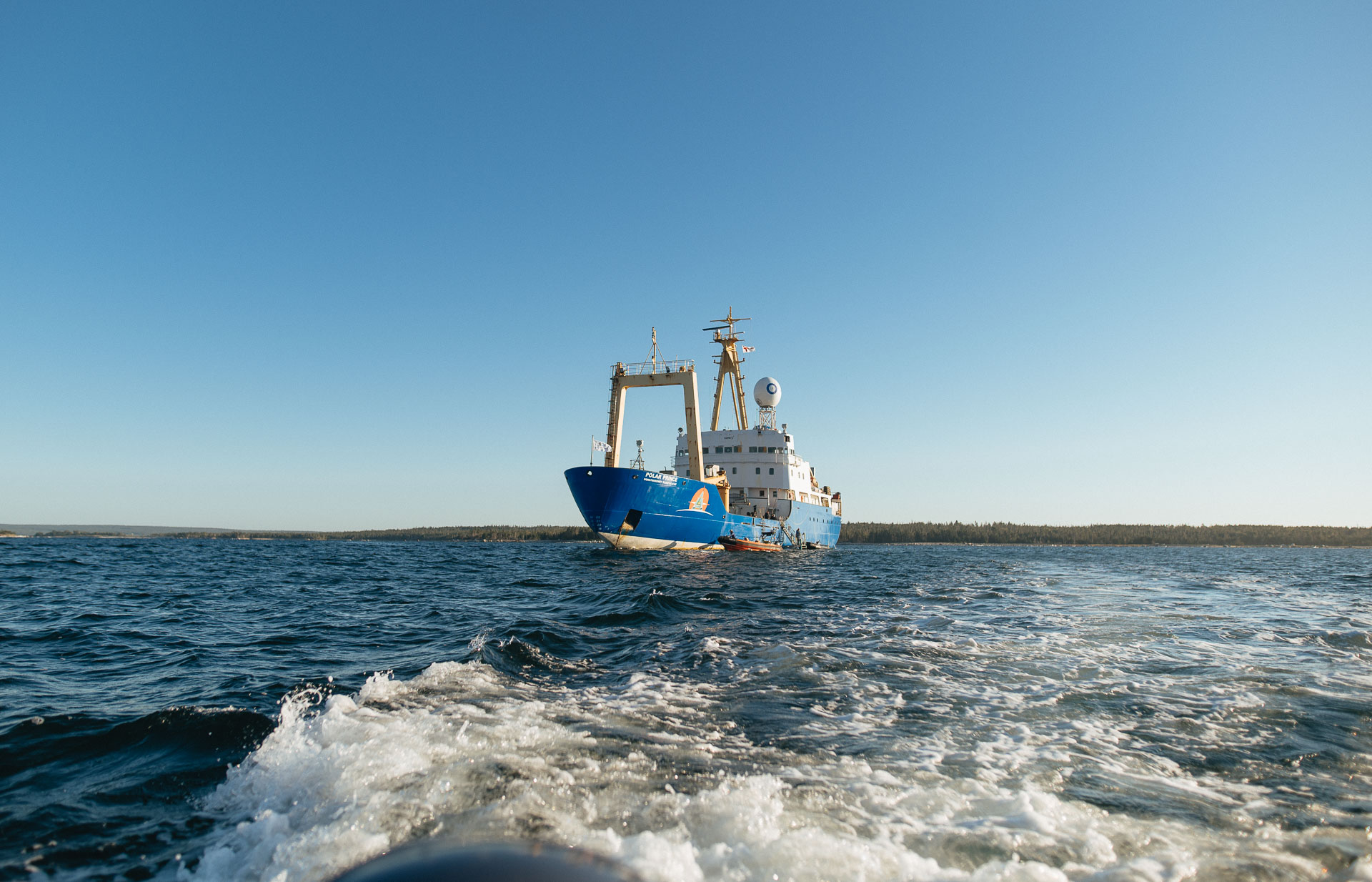




Nunavut to Kalaallit Nunaat Expedition: Update 3
The final stretch of our epic journey took us across the Davis Strait into Kalaallit Nunaat (Greenland), where we deepened our understanding through cultural exchanges, workshops, and moments of reflection amidst the breathtaking landscapes of the Arctic.

Crossing to Assaqutaq
Smooth seas carried us across the Davis Strait, where wildlife sightings (including fin and blue whales!) interrupted a morning of climate change and biodiversity presentations and workshops by J. Sherman Boates and Gwen Freeze. Some of us also checked in with Adventure Canada’s cultural education team. “The discussion with the cultural educators was very fulfilling, and it was nice to be listened to and heard,” one participant said.
After, our group attended presentations by Chloe and Andrew, who discussed their research on the invasive European Green Crab and fossils in Nunavut and Greenland, respectively. We took in Inuk interpreter, translator, cultural educator, and advocate Martha Flaherty’s powerful documentary, Martha of the North, which tells of the generational impacts of forced Inuit relocation by the federal government. The film stirred up lots of emotions among our group.
Later, Malou gave us a Greenlandic welcome before our first landing in the fishing settlement of Assaqutaq. The highlight of the landing was a walk across a short suspension bridge and meeting a couple of local children who welcomed us with open arms and hearts. A rousing round of karaoke closed the night, with lively performances by Ijeoma, Chelsea, Andrew, P.J. and the dulcet tones of Byron.

Sailing into Sisimiut
A full day in Sisimiut allowed us to visit museums, craft shops, and experience traditional Greenlandic culinary offerings. Tastings of reindeer soup, lungfish roe, muktuk (whale), and dried cod opened dialogue on food sovereignty and cultural practices. Jordan was inspired by the sight of hydroponic agriculture at a local farm, noting her own community would benefit from similar initiatives.
Meantime, the group saw a wind turbine installation at a test centre in Sisimiut, a project by the government-owned energy company, Nukissiorfiit. The turbines were set up in 2018 to test the potential of providing green energy to remote off-grid communities that otherwise rely on diesel generators. Since then, the community of Ammassivik has seen solar and wind installations and Nukissiorfiit has plans to roll out more installations across the country. Manu questioned the absence of this type of green energy infrastructure in Nunavut and across the North more generally, committing to research similar solutions and making connections in Greenland when he returns home.

Ice-Packed Ilulissat
The following day, we made our way north up the west coast of Greenland towards the community of Ilulissat and Sermeq Kujalleq (aka the Jakobshavn Glacier, which runs into the Ilulissat Icefjord—a narrow, 55-kilometre-long channel where the icebergs of all sizes accumulate before eventually floating out to sea). The Ilulissat Icefjord was recognized by UNESCO in 2004 for its unique glacial dynamics and the dramatic landscape created by the calving glacier.
Plans to land in Ilulissat were thwarted by ice, but this pivot offered what became a highlight: zodiac cruises among towering icebergs of the Ilulissat Icefjord. We all noted their scale and beauty, observing soil stains, ice caves, and bands of photosynthesizing bacteria on the surface. Jordan reflected that striations on the ice resembled “tunniit and kakiniit (traditional tattoos),” underscoring the ties between land, art, and identity. Byron added, “Seeing all the different icebergs…was like looking at a time machine.”
Later in the day, Devon led a session on dog sledding. A hunter, expedition leader, and self-taught dogsledder from Resolute, Nunavut, Devon has been reviving the practice in his community. This year he was named an honoree of the Explorers Club 50 program, which annually highlights 50 people changing the world. After, PJ and Shanon demonstrated Inuit games. It was a great way to spend the afternoon—blending cultural learning with play. That evening, we all took the time to express our gratitude through letters to sponsors, marking the growing awareness of reciprocity and responsibility.
Nordre Isortoq & the Arctic Circle
Heavy swells overnight gave us a taste of a “true expedition.” The day’s landing at Nordre Isortoq offered several different route options for hikes—each themed around either geology, botany, ornithology, storytelling, and biodiversity. Afterwards, a polar plunge above the Arctic Circle brought exhilaration, while the evening huddle brough self reflection as youth wrote letters to their future selves. Reflection on growth, resilience, and community defined the day.
“This has really been a trip and an experience of a lifetime, one I will truly never forget,” Jordan reflected. “I’m so thankful to be a Student On Ice, and so glad I met 16 other incredible youth who are all over the globe doing amazing things in their respective fields. I can’t wait to see where they go and see what they do.”

Throughout our time together travelling between Nunavut and Greenland, we were privileged to gain insight into environmental stewardship while making plenty of time for personal growth. We also gained a new appreciation for the Inuit cultures of Canada and Greenland. The experience illuminated how, in the words of J.R., “Maybe those who are still connected to the land and the water and earth are remembering something the rest of us have forgotten.”
The expedition ended not just with memories, but with commitments—to carry these lessons forward into communities, careers, and futures shaped by the Arctic’s enduring wisdom.