



North-to-North Expedition 2026: Expedition Recap
The physical voyage of the 2026 North-to-North Expedition has concluded, but the connections forged across the waters of Greenland and Canada are just beginning. Endorsed by the United Nations Decade of Ocean Science for Sustainable Development, this journey brought together a diverse cohort of 90 youth participants, Indigenous Knowledge Holders, scientists, artists, and other educators representing Canada, Alaska, the Nordic countries and autonomous territories—Denmark, the Faroe Islands, Finland, Greenland, Iceland, Norway, Sweden, and Åland. Living and learning together aboard our floating classroom, the MV Ocean Nova, the expedition marked a milestone by celebrating the 30th anniversaries of both the Arctic Council and the Nordic Arctic Programme of the Nordic Council of Ministers. Backed by three key partners—Global Affairs Canada, the Nordic Council of Ministers, and the Arctic Council—this expedition stood as a living example of cross-border relationship-building and international cooperation.
The journey began in Ottawa, Canada’s capital, where the cohort gathered on the Carleton University campus to begin building their community. Initial travel nerves quickly faded during walks along the Rideau Canal and a visit to the National Gallery of Canada, where the group stood before Qillaniq, an exhibition of contemporary circumpolar Indigenous art. This exhibition included work by one of the expedition’s own educators, Inuk artist and biologist Jessica Winters from Makkovik, Nunatsiavut, setting an early tone for how science, art, and culture would remain intertwined throughout the voyage.
As part of preparing for life aboard the ship, the youth also collaborated on a Community Agreement. Rather than creating a list of rigid rules, they established shared values—including patience in communication, approaching the journey as lifelong learners, and respecting diverse opinions.

The transition from land to sea began with a three-and-a-half-hour charter flight from Ottawa to Nuuk, Greenland. Upon arrival at the newly expanded Nuuk Airport, the team was welcomed by NAPA, the Nordic Institute in Greenland, for a meal of local cuisine accompanied by traditional East and North Greenlandic drum dancing.
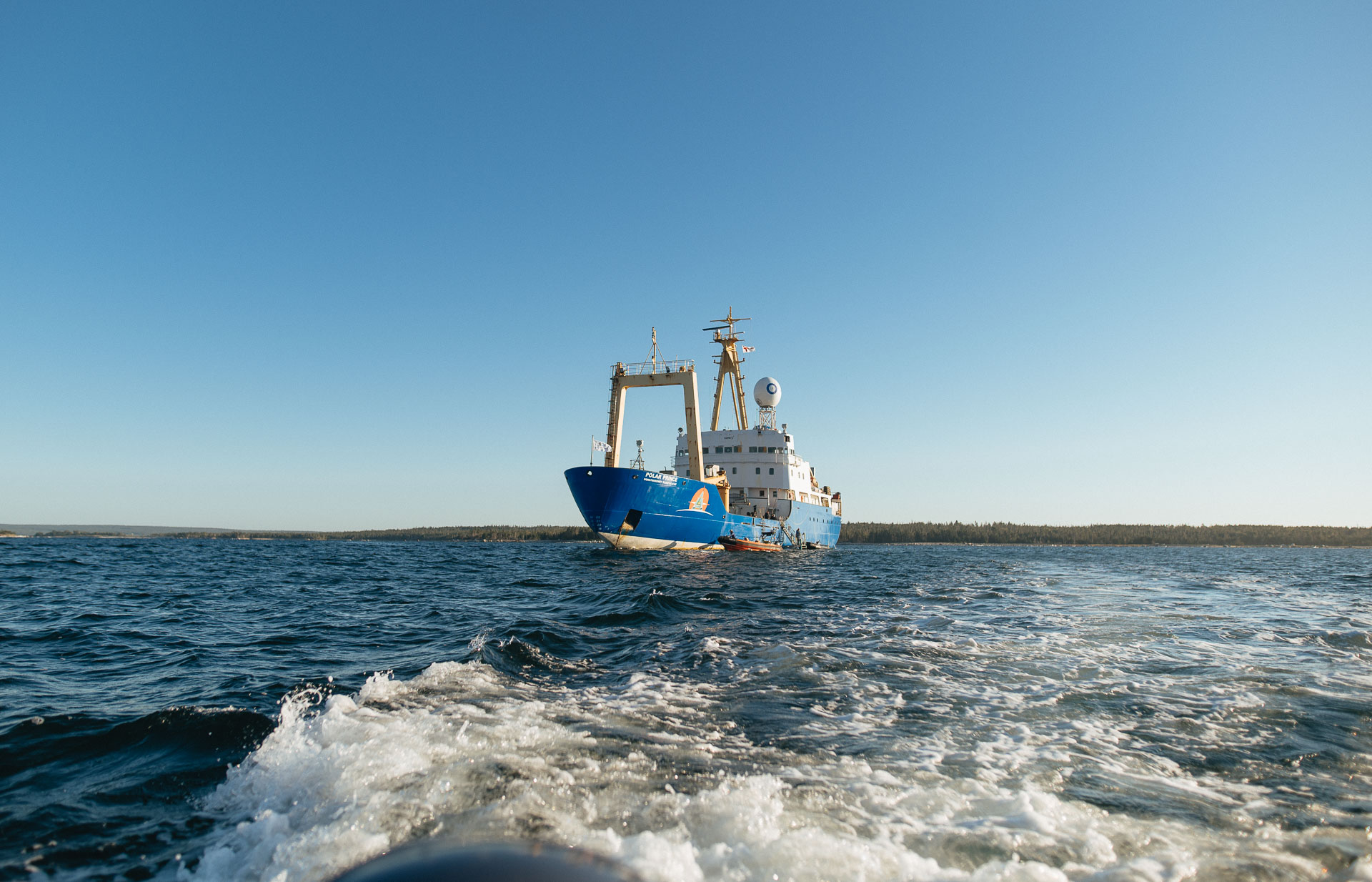
Standing by the damp coast of Old Town Nuuk, the cohort caught their first glimpse of the MV Ocean Nova anchored in the harbour. For many, boarding the ship was in itself a milestone, representing the start of two weeks in our floating home and classroom. On board, the overarching theme of governance, democratic values, and self-determination came to life. The cohort learned about Greenland’s political history, from colonization in 1721 to the achievement of self-governance in 2009. This exploration of northern diplomacy was grounded by the perspectives of our shipboard educators. Camila Aviaja, who works in the Ministry of Foreign Affairs in the Government of Greenland and serves as Chair of the Arctic Council’s Sustainable Development Working Group, explained the transition of Greenlandic governance and how collective rule requires consensus among all twelve ministers. Canadian Foreign Service Officer Julie Croteau brought her firsthand perspective as a diplomat, sharing her work in establishing Canada’s new consulate in Nuuk, which opened in November 2025 to focus on political engagement, commercial opportunities, and people-to-people connections.

Sailing south, the ship repositioned at Qaqortoq, a town of 3,000 people defined by colourful houses tiered along steep, rocky hills. Here, the group welcomed Kenneth Høegh, Chair of the Senior Arctic Officials of the Arctic Council, who shared his extensive life and professional experience in South Greenland and circumpolar diplomacy to the shipboard program.
Kenneth’s talks focused on the theme of sustainable development and community resilience. He introduced the cohort to the team from Tanbreez Mining, who presented on their critical minerals mining project at Killavaat Alannguat. The youth learned about the geological origins of this site—created by a volcano that never erupted—resulting in one of the largest undeveloped rare earth element deposits in the world. Exploring the local facility and examining geological test cores, the group discussed how the project could provide a 120-year economic boost to the region following the decline of the local fishing industry, sparking a balanced discussion on resource management, community consent, and economic futures. After the tour, the youth explored the town, running onto local pitches for friendly, high-energy soccer matches with resident youth and Swiss tourists, further reinforcing the people-to-people connections of the journey.

The physical reality of a warming climate was brought into sharp focus in Tasermiut Fjord. Guided by climate scientist Maureen “Mo” Raymo, the youth observed how the active glacier has recessed more than a kilometre from where the ice met the salt water twenty years ago. Huddling the Zodiacs near the ice face, Maureen explained the physics of the Greenland ice cap, which loses 271 gigatons of ice mass each year. This firsthand observation of climate change left a deep impression on the youth, captured by Riley Cyre’s reflection: “I was tired this morning, until I stepped outside and saw that glacier. I felt rejuvenated, re-energized… It’s now our job to protect that glacier, that ice cap”.
Steven Guilbeault, Canada’s former Minister of Environment and Climate Change, expanded on this theme during shipboard sessions, tracing the global rise of fossil fuel use and Canada’s climate challenges. He raised conversations about the clean energy transition, highlighting renewable energy efforts in the United States and China, individual solar panel installations in Pakistan, and the increasing efficiency of electric vehicles. This theme carried onto Uunartoq Island, home to natural thermal springs fed by geothermal energy. In addition to soaking in the warm, 38-degree Celsius water and looking out at drifting icebergs, participants engaged in environmental stewardship—the responsible use and protection of the natural environment through sustainable practices—and scientific monitoring. Paul Hamilton collected water samples to study algae and microhabitats, while Maureen led a citizen science project for the Geological Survey of Denmark and Greenland, using a geophysical meter to measure pH, temperature, and conductivity to show how thermal springs serve as windows into subsurface processes.

The two day crossing from Greenland to Canada across the Davis Strait served as an intensive classroom in motion, focusing on knowledge sharing and dialogue. During the transit, Whitney Lackenbauer, Professor and Canada Research Chair in the Study of the Canadian North, hosted a timely session on Arctic boundaries and security. The group explored how borders function on local and international scales, discussing maritime boundaries, continental shelves, the 2022 Hans Island (Tartupaluk) agreement, and Canada’s historic internal waters.
Despite the rolling seas, a variety of hands-on workshops buzzed in every corner of the ship. Music and art became major conduits for dialogue. Mia Kelly and Aasiva Nakashook co-led sessions where youth practised singing in harmony. They worked on a collaborative song written by the youth, blending English and Inuktitut to find common ground through music. Artist Jessica Winters led visual arts sessions where youth painted in a variety of styles and mediums. In these shared spaces, the youth opened up about their homes and families, with one participant noting, “As the ship rocks, so does our conversation”.

The ship crossed into Canadian waters, to arrive at Torngat Mountains National Park in Nunatsiavut, Labrador—a massive wilderness whose name is derived from Tongait, the Inuktitut word for “place of spirits”. This park is co-managed by Inuit, and the cohort’s time on the land was deeply guided by Indigenous knowledge.
Senator Nancy Karetak-Lindell shared an intimate presentation about her life, speaking candidly about growing up during a period of forced relocations, residential schools, and government-issued identification numbers, before her historic election in 1997 as the first Member of Parliament for the riding of Nunavut. Nancy introduced the cohort to the Maligait (the four traditional Inuit laws) of common good, respectful relationships, harmony, and planning for the future. Lynda Brown, Alumni Team Lead, expanded on these teachings by introducing the eight core Inuit Qaujimajatuqangit (IQ) principles, while coastal Sámi leader Gunn-Britt Retter shared Sámi environmental values and stories of traditional stewardship from Sápmi. These diverse Indigenous perspectives were woven into our landings at historic sites. At Ramah Bay—home to ten Avanimiut sod houses and a 5,000-year-old quarry site of Ramah chert—Lynda gathered the youth on the beach to teach them the art of throat singing, which sparked friendly, spirited competitions. On the beach at North Arm, Nancy and Jessica Winters showed the group how to make traditional bannock over an open fire, which the cohort enjoyed alongside fresh Arctic char caught along the coast. At Eclipse Sound, the cohort navigated river rapids by Zodiac to hike along a cascading waterfall, observing nesting peregrine falcons along the cliffs.

These land excursions were balanced by academic and scientific dialogues. Archaeologist Emma Gilheany led discussions on how to conduct collaborative archaeology that respects local Indigenous consent. Geologist Peter Croal hosted a session on “Geology, Mining, and Reconciliation,” explaining mineral formation and emphasizing that community consent and local support are just as vital to resource development as the geological ore body itself.
As the MV Ocean Nova continued north, Baffin Island and its surrounding waters served as an active marine laboratory. Boarding Zodiacs to cruise along the sea-ice edge, the cohort observed walruses and polar bears in their natural habitat, prompting Geoff Green to reflect on the importance of habitat conservation: “That is their habitat, that is where they want to be… Where they should be”. Bird ecology came to life under the guidance of biologist Rielle Hoeg, who taught the cohort how to identify seabirds in flight and analyse their populations. At Hantzsch Island, a protected Important Bird Area, the group boarded Zodiacs to observe thick-billed murres, black-legged kittiwakes, northern fulmars, and puffins nesting on the steep cliff faces.

Scientific inquiry was integrated directly into these outings. On a dedicated science Zodiac, Scott Carr used an ocean sound meter provided by JASCO Applied Sciences to introduce youth to underwater acoustics, allowing them to listen to real-time audio from beneath the surface to monitor human-caused ocean noise. Paul Hamilton led hands-on plankton net hauls near the island, collecting samples of golden-brown algae and demonstrating how high volumes of bird droppings act as a natural fertilizer to stimulate marine plankton blooms. Bringing this data back to the ship, the youth prepared microscope slides and analysed marine samples, connecting field observations directly to laboratory science.
The expedition concluded on July 22 in Iqaluit, the capital of Nunavut. Exploring the fly-in community of 9,000 people, the youth observed how the town manages modern challenges—relying on sea-lifted diesel fuel and flown-in perishable food while embracing new developments like Starlink and a deep-sea port. At Cadet Hall, the departing North-to-North cohort gathered for an emotional transition ceremony with the incoming youth from the second SOI expedition who would take our places on the vessel to begin the reverse journey to Greenland.

As the last hugs were shared in Cadet Hall and the group turned toward home, the true impact of the journey became clear. The 2026 North-to-North Expedition was never just about the miles travelled; it was about the borders crossed through dialogue and the shared commitment to an Arctic future defined by cooperation, resilience, and respect. From the glaciers of Greenland to the rugged beauty of Nunatsiavut, our youth have become a global family, bound by the values of environmental stewardship and mutual understanding. This expedition, made possible through the generous support of Global Affairs Canada, the Nordic Council of Ministers, the Arctic Council and so many other SOI partners, has shown that our collective future relies on these connections. These young leaders are now returning to their home communities as the newest stewards of the North, ready to turn the lessons of this voyage into meaningful, lasting action.