



North-to-North Expedition 2026: Update 4
After crossing the Davis Strait and catching our first views of the Canadian coastline, the North-to-North Expedition officially arrived in the place of spirits: Torngat Mountains National Park, Nunatsiavut, Labrador. Over the next three days, our floating classroom and the shores of Labrador have served as the perfect backdrop for hands-on science, deep personal reflection, and unforgettable land and sea-based adventures.
Friday, July 17
On Friday morning, our cohort divided into two large groups to make the most of our first full day in the park. While one group remained on the ship for specialized workshops, the other headed ashore, with the teams swapping places in the afternoon to ensure everyone experienced the full magic of the land and the vessel.
For the morning workshops on board, journalist Althia Raj led an engaging session on how to turn raw ideas into compelling stories. The group worked together to build a narrative framework, deciding to dive deeper into “Youth Leadership”—one of Students on Ice’s core pillars. They focused their storyboard on youth participant Priscilla Frankson, who had brilliantly exemplified leadership throughout the journey. When the team proudly presented the finished storyboard at the evening briefing, a touched Priscilla admitted she was blushing, to which Geoff Green warmly responded that her recognition was well deserved.
Down in the quiet sanctuary of the ship’s library, Mo and wellness team member Jess co-led a heartfelt sharing circle focused on “Eco-Anxiety”. Mo had approached Jess with the idea, wanting to create a supportive space to unpack the heavy feelings that can arise when learning about environmental challenges. The circle began with an open discussion on the difference between daily stress and deeper anxiety. To guide their conversation, the group passed a red spool of yarn across the room as each person spoke, creating a physical web that beautifully illustrated how they are all connected in their struggles. After taking time to validate these vulnerable emotions, they switched to a green spool of yarn, passing it around to share practical coping strategies and messages of hope. It was a great opportunity to speak heart-to-heart, and for many on board, the session simply felt right.
The next session on board was co-led by Priscilla Frankson and Camilla Aviaja, focusing on Subsistence Practice. Together, they opened up an honest space to explore what hunting means in different northern and international contexts. The group shared personal stories about hunting, examining its cultural and practical significance. They also discussed how to communicate these vital traditions to those outside their communities, brainstorming ways to address some of the common stigmas and misunderstandings surrounding harvesting practices in the North.
When the shore team returned to the ship for the afternoon, a new set of workshops awaited them: Biologist Rielle Hoeg hosted a unique session on bird eggs, teaching participants how to measure an egg’s width, length, and age. She explained the technique of “grubbing”—how researchers safely retrieve and return eggs to nesting burrows—and even set up a practice model using a vinyl drain spout so the youth could test out their skills.
Nearby, Mia Kelly led another songwriting workshop, but this time she challenged the youth to lead the creative process themselves. Focusing on the theme of “home,” the writing session was deeply emotional and difficult for some, while for others it flowed as a poetic and comforting reflection.
In a third circle, Gunn-Britt Retter led a workshop on Indigenous Peoples Movements, focusing on how to drive real change within their own communities. They discussed how to analyze pressing issues, identify the right decision-makers, and map out exactly who to contact to successfully advocate for community needs.
When the morning’s ship team made their landing on the beach in North Arm, Parks Canada Media Officer Lindsey Moorhouse was there to officially welcome them to the majestic park. The beach quickly became a hive of activity, offering something for everyone. Some participants set off on a hike led by archaeologist Emma Gilheany, who pointed out historical archaeological sites and led a thoughtful discussion on the localized effects of colonization. The trail ended at a stunning waterfall, where a few brave souls even went for a refreshing swim in the cold water.
Meanwhile, others took to the water on paddleboards and kayaks—with many first-timers cheering each other on—while another group tried their hand at fishing. Back on the sand, we built a fire. Gathered around, artist Jessica Winters and Senator Nancy Karetak-Lindell showed the group how to make traditional bannock over the open flames, which we enjoyed alongside the fresh-caught Arctic char.

To ensure the expedition also gave back to the scientific community, biologist Paul Hamilton launched an ambitious research initiative on the beach with the goal of gathering enough data for a future scientific publication. His team established a multi-pronged approach: first, they created a structured methodology to measure how coastal plant life changes the further you move inland from the shore. Second, they collected samples to compare the diatoms of the Torngat Mountains with the samples gathered earlier in Greenland. Finally, the group kicked off a comprehensive “biodiversity blitz,” attempting to identify and log as many different plant species as possible at each and every beach landing of our trip.
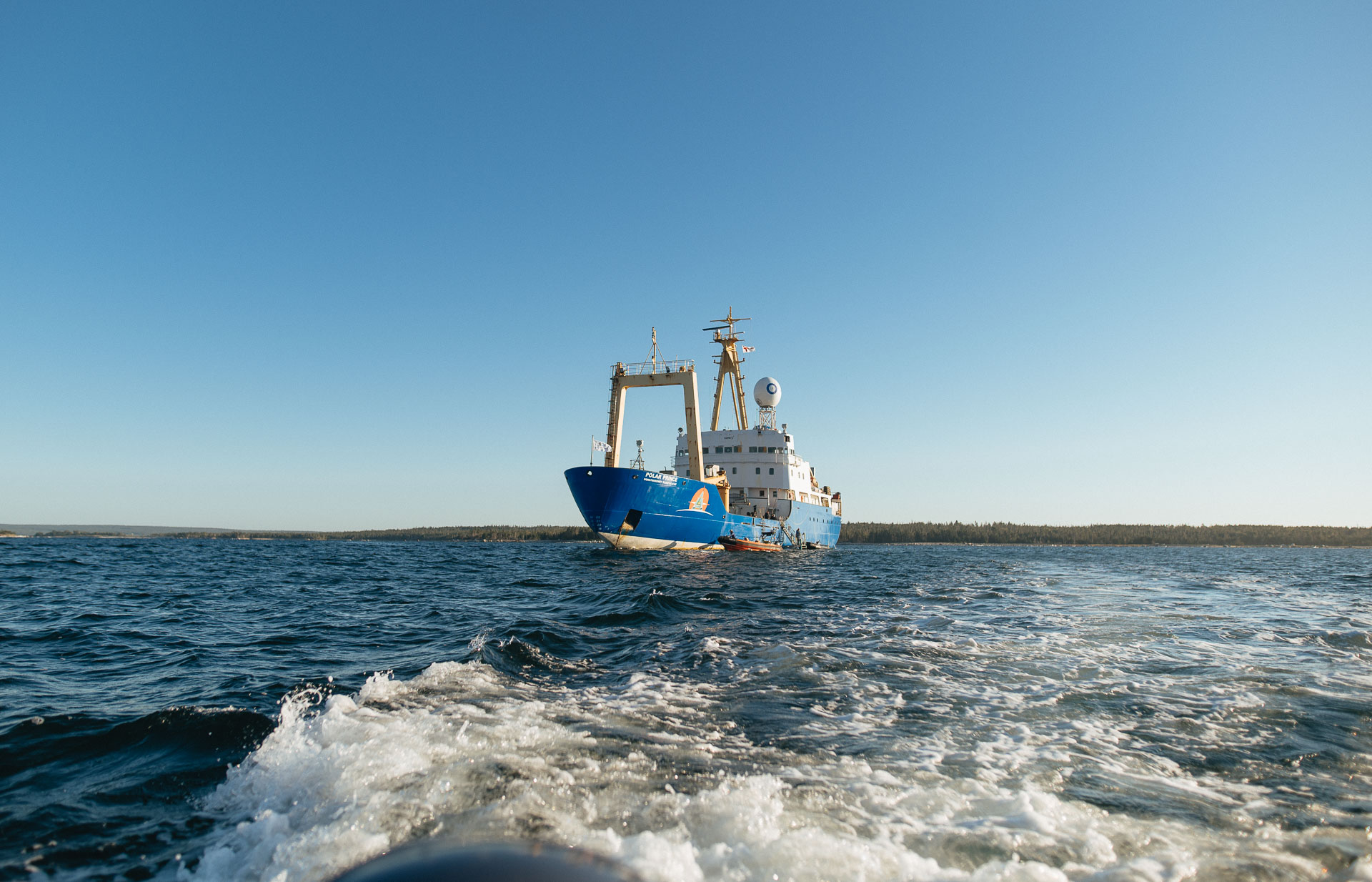
After a full and rewarding day of swapping places between the ship and the shore, the entire cohort reunited aboard the MV Ocean Nova for dinner and our evening briefing to share highlights from our first day in Labrador.
Saturday, July 18
Our morning began with a Zodiac ride to the historic shores of Ramah Bay. This significant site holds thousands of years of human history; it was home to the Avanimiut people, and the remnants of ten sod houses still stand on the landscape. Ramah Bay is famous for its abundance of slate, which Inuit historically used to make ulus (knives). It is also the legendary site where people have quarried unique Ramah chert for over 5,000 years.
On the beach, we built a warm fire to make bannock, while Alumni Team Lead Lynda Brown gathered the youth to teach them the art of traditional throat singing. What was meant to be a brief lesson turned into a series of friendly, passionate throat-singing competitions that went on much longer than planned because everyone was so highly engaged!
A group set out on a scenic hike up the mountain to take in the spectacular, sweeping views of the bay. Along the way, we stumbled upon a patch of snow and couldn’t resist the fun of sliding down. The hike was cut slightly short when our vigilant bear guard spotted a black bear further up the slopes, prompting a safe and orderly descent back to the beach. Back at the beach, paddleboards were launched, and a few daring participants even managed to catch and surf the waves crashing onto the beach—a feat our guide believed was a historical first for Ramah Bay! Others braved the chill to put on their swimsuits and stand directly under a powerful coastal waterfall.

After returning to the ship and setting sail for our next destination, Senator Nancy Karetak-Lindell shared a very powerful and intimate presentation about her life. Nancy spoke candidly about growing up during a period of massive, rapid change for Inuit. She shared the painful reality of being born with a government-issued identification number instead of a name, and how her ancestors’ seasonal camp-based way of life was disrupted when communities were forcibly relocated and subjected to strict new regulations, including a ban on traditional bowhead whale hunting. Sickness spread, and youth were sent to distant residential schools where they were forced to learn English. Nancy moved the room deeply when she reflected, “I lived through these years, and I’m not even that old.” Driven by a desire to build a better future for her four sons, Nancy ran for office and made history in 1997 when she was elected as the first Member of Parliament for the newly established riding of Nunavut, ultimately serving her constituents for 11 years. She spoke about the delicate balance of navigating “two worlds” (the South and the Arctic) and advocated passionately for adapting to modern realities while fiercely preserving Inuit culture and traditions. On behalf of Students on Ice, Geoff Green expressed his deep gratitude to Nancy for her lifelong dedication to the North and to Canada.
By late afternoon, the ship made its way into the majestic Nachvak Fjord, surrounded by towering cliffs of 3.6-billion-year-old rock—some of the oldest rock on the planet. We loaded back into the Zodiacs for a spectacular cruise up Tallek Arm, where we were treated to sights of polar bears and more black bears along the dramatic shoreline.

During our evening debrief, geologist Peter Croal shared a deeper look into the region’s geological history, highlighting the vital role of tectonic plates. The high energy of the day carried late into the evening. Lynda Brown kept the throat-singing spark alive by organizing an epic Starboard vs. Port friendly competition. With educator Aasiva Nakashook captaining the Starboard side, they narrowly claimed the win in a room filled with laughter. To add to the excitement, Steven Guilbeault shared a personal, encouraging message to the cohort from Prime Minister Justin Trudeau, which included a special shout-out to youth participant and big fan Jazzlynn Tetlichi. We closed out this unforgettable day with a beautiful performance by Mia Kelly and a group of youth, who sang the wind-themed song they had collaboratively written earlier in the week.
Sunday, July 19
Our final stop in the spectacular Torngat Mountains National Park brought us to Eclipse Sound (often called Eclipse Channel), a stunning, steep-sided fjord and river valley located at the northern end of the park. Our morning began with a Zodiac ride to shore, where we were delighted to see curious seals playing in the shallow waters. We then used the Zodiacs to navigate up the river toward the waterfall, which was an exciting adventure as our drivers guided us through a fun set of fast-moving rapids. Along the steep cliff line, we observed different nesting birds and even spotted a peregrine falcon.
On land, we set off on a scenic hike along the river. Looking down from above, the water was a vibrant, brilliant blue, and the top of the hike rewarded us with a stunning, sweeping view of the landscape. We spent time taking photos, hoping to preserve the memory of our final moments in this incredible wilderness.

As the MV Ocean Nova pulled anchor and began its journey north, the lounge transformed back into our shipboard classroom for a packed afternoon of presentations and specialized workshops.
We began the afternoon with a presentation titled “Life in Hopedale,” co-led by youth participants Madison Dicker, Bianca Winters, Jamie Pijogge, and Marissa Winters. They introduced the cohort to Hopedale, the second most populated community in Nunatsiavut, which is home to 640 people. The girls described their local school—which runs from Kindergarten to Grade 12 with approximately 130 students—and shared how they look forward to sports meets twice a year to compete against other northern schools. The youth spoke candidly about the painful history of residential schools in their community, explaining how their parents and grandparents were forced to speak English and subsequently lost their native tongue. Reflecting on this legacy, one presenter shared a powerful sentiment: “If I had to choose a language, I would choose my people’s language.” Despite these historical challenges, they highlighted the beautiful, active nature of modern life in Hopedale—sharing their love for hunting, fishing, and berry picking, and describing how the cold winter months bring a unique sense of freedom when the area freezes over, allowing community members to drive anywhere on the ice.
Following their presentation, participants broke out into multiple specialized afternoon sessions:
Camilla Aviaja hosted a workshop focused on negotiations and concession decision-making. The group explored different styles of negotiation and discussed creative ways to find compromises across languages. Putting their new diplomatic tools to the test, the youth engaged in a collaborative mock negotiation to draft a formal Students on Ice statement regarding the human right to clean water.
In another circle, Nancy Karetak-Lindell, Lynda Brown, and Gunn-Britt Retter co-led a session exploring “What the Inuit and Sámi Have Always Known”. Nancy introduced the group to the Maligait (the four traditional Inuit laws): the common good, maintaining respectful relationships with all things, living in harmony and balance, and planning for the future. Lynda expanded on this by sharing the eight core Inuit Qaujimajatuqangit (IQ) principles. Bringing in her Sámi perspective, Gunn-Britt noted that while the Sámi do not have a single codified document of laws, they share many environmental and cultural principles. She illustrated this by sharing a warm childhood story of learning how to pick berries on the tundra simply by observing her mother. The session sparked an active, thoughtful conversation about how youth can balance and apply these traditional Indigenous principles while navigating non-Indigenous settings.
Whitney Lackenbauer hosted a timely session on the militarization of the Arctic. The group analyzed the various global narratives surrounding military threats through, to, and in the North, discussing the complex interplay between changing climates, new technologies, and international competition. Bringing in their own diverse national backgrounds, the youth considered different security threats based on geography, neighbors, and alliance commitments. They concluded with a deep dive into the historical causes of militarization and what these national security efforts have meant historically for Arctic Indigenous Peoples and their traditional ways of life.
The cohort also had the opportunity to join repeated sessions of previous workshops they may have missed—including painting with Jessica, singing in harmony with Mia and Aasiva, and the eco-anxiety sharing circle with Mo and Jess, ensuring everyone had a chance to participate.
View the full gallery here!