



North-to-North Expedition 2026: Update 3
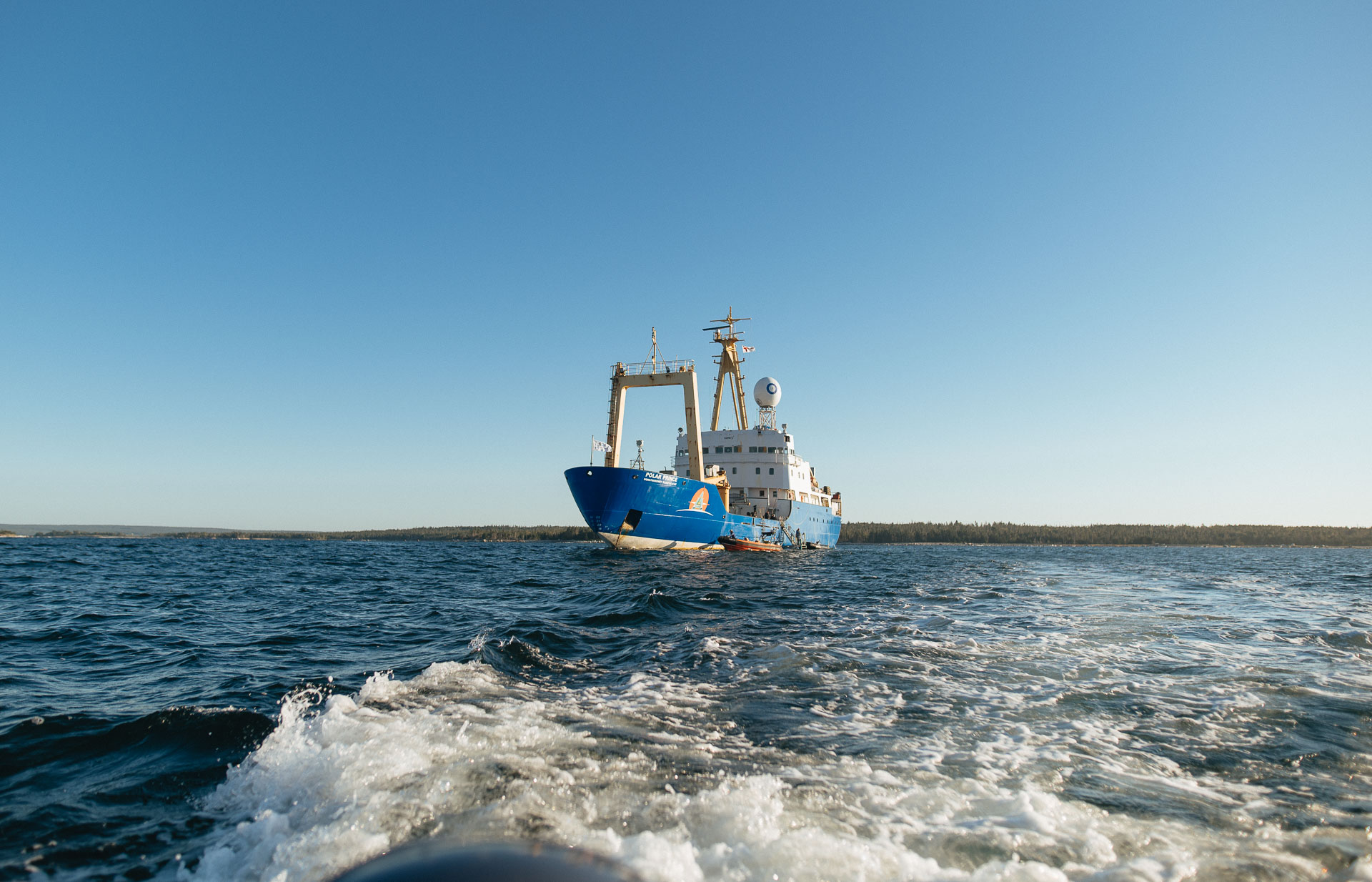
With our time in Greenland drawing to a close, the North-to-North Expedition shifts from the dramatic, ice-sculpted fjords of South Greenland to the wild shores of Canada. Crossing the Davis Strait marked a transition not only of geography, but of spirit—a time for deep reflection, ship-based activities, and the strengthening of cross-border connections.
Tuesday, July 14
After sailing through the night to arrive off the coast of Uunartoq Island, we began our final day in Greenland on a celebratory note, wishing Haukur a very happy birthday. Boarding our zodiacs, we headed ashore where we were met by Pele and Fari, our exceptional local guides. Fari warmly welcomed us to the island with samples of traditional muktuk and dried fish. Uunartoq is famous for its natural thermal springs, which—unlike the volcanic pools in neighboring Iceland—are fed by geothermal energy pushing crystal-clear water up into a series small, stone-dammed pools. Sitting in the perfectly warm, 38-degree Celsius water, we enjoyed a sulfur-free soak while looking past the grassy shoreline at drifting icebergs and distant peaks. While ashore also rotated through a series of land-based workshops.

Mia Kelly led an immersive songwriting workshop. Participants used seven plates as creative prompts—one for each of the five senses, plus two dedicated to feelings—to capture words and phrases about their expedition experience so far. After discovering a recurring thread of ‘wind’ throughout their reflections, the youth collaborated to weave these quotes into a song.
Paul Hamilton collected water samples to study algae and microhabitats in each pool, while Maureen (Mo) Raymo led a citizen science project for the Geological Survey of Denmark and Greenland, measuring pH, temperature, and conductivity with a multipurpose geophysical meter. As Mo noted, “Thermal springs are windows into what is happening beneath the earth’s surface”.
Jessica Winters introduced participants to traditional Inuit games that test strength, endurance, flexibility, and patience—key traits for hunting and survival in harsh conditions. The group laughed and challenged one another to games such as leg wrestling, high kick, thong pull, and the owl hop. James Nungak stood out as the only participant to successfully complete the challenging one-arm reach, while Nick Boulos bravely challenged our guide—who happened to be a local champion—to a muskox push.

Our guide local Pele took us on a hike to nearby Thule ruins to show us the stone remnants of ancient subterranean homes while sharing the fascinating story of Usulissuaq.
After everyone had a chance to soak, we bid farewell to our team members Julie Croteau, Kenneth Høegh, and Niya Høegh, who had to remain in Greenland for their ongoing diplomatic and policy work. Julie grew emotional after forming such close bonds with the cohort over the past week. Kenneth left us with an encouraging reminder that he would rejoin us in Iqaluit, where he will be attending the 15th General Assembly of the Inuit Circumpolar Council.
Once back on the ship, we pulled up anchor and began our long journey across the Davis Strait toward Canada. As we sailed, Althia Raj gathered us in the lounge for a journaling workshop. We discussed how writing can organize thoughts, document our lives, and build closure, then took ten minutes to put pen to paper. It was a quiet moment that brought out mixed but honest feelings; as we shared afterward, one student found the exercise deeply relaxing, while another admitted it was actually very stressful! It was also a great way to begin processing all the incredible experiences of our last few days in Greenland.
We spent the rest of the afternoon divided among several creative and scientific activities. While some participants continued writing in their journals, others painted and drew on tiles that artist Jessica Winters will later assemble into a collaborative mosaic. Meanwhile, another group joined biologist Paul Hamilton to learn how to prepare microscope slides using the water samples collected earlier in the day. Upon examining the slides under the microscope, the group was surprised to discover that diatoms were completely missing from the samples. This unexpected finding sparked a lively scientific discussion, prompting a humbling reflection from Paul: “I was in shock to not see what I expected to see… sometimes the more you know, the less you know.”
Wednesday, July 15
Our journey across the Davis Strait was met with high winds and rolling seas. While seasickness affected many of us on board, the ship’s educational programming continued in full force.
Rielle Hoeg kicked off the morning with a presentation on the state of seabirds in Canada, sharing a detailed breakdown of their populations: 27% of species are in decline, 21% are increasing, 20% show little change, and 28% still lack sufficient data. After discussing threats like climate change, avian influenza, invasive predators, and light pollution, we explored practical ways to help, from advocating for marine protected areas to reducing plastic and artificial light pollution. Following the talk, Rielle took a group to the bow of the ship to teach them the underrated skill of spotting birds in flight using binoculars.
Throughout the rest day, our floating home buzzed with hands-on activities, with workshops tucked into every warm corner of the ship. Priscilla Frankson ran a popular beading workshop where youth braved the rolling swells to construct brick-stitch earrings. The constant rocking of the vessel made handling the tiny beads a humorous test of fine motor skills, but the participants persevered, laughing through the challenges of crafting on a moving sea.

In another part of the ship, Aasiva Nakashook led an intimate Inuit storytelling session where participants shared both traditional legends and their own personal stories. As the group listened and opened up, they began to recognize the deep threads of connection that run across the North. Even when names and small details change from region to region, they noted that traditional stories share a common moral and message across the circumpolar Arctic.
Emma Gilheany introduced the physical and artistic craft of flint knapping. To spark inspiration, Emma shared books and photographs of ancient stone tools discovered in the Torngats, showing the youth what these historical implements looked like. She also brought along Georgetown chert, a type of stone that is highly responsive to shaping. Using copper billets and antlers, students worked diligently to flake and shape the rock, trying their hands at creating their own tools. Through this trial, the youth quickly realized the immense patience and precision required for the craft. The group discussed how this skill represents a profound transfer of knowledge passed down through generations—a hands-on experience that is beautifully part intellectual, part physical, and part artistic.
In the afternoon, Scott Carr explained a collaborative partnership with the Department of Fisheries and Oceans (DFO). Scott introduced a series of ocean drifters—floating scientific instruments developed to track currents, temperatures, barometric pressure, and salinity across the Davis Strait. Our youth participants had the special opportunity to name these devices before they were deployed into the ocean where they will relay real-time data back to researchers on shore.
Mia Kelly hosted a watercolor journaling workshop where participants painted a small, colorful scene to represent each day of their journey. Far more than just an art class, the quiet, focused space became a setting for deep personal storytelling. As the youth painted side by side, they opened up about their homes, families, and personal lives, turning the creative session into a powerful bonding experience. Even as the ship rolled heavily through the rough Davis Strait swells, the motion seemed to set a candid rhythm for their sharing, prompting one participant to beautifully observe, “As the ship rocks, so does our conversation.”
Youth participant Emilie Biti-Jessen, who has a coastal Sámi background, led a hands-on workshop introducing the traditional Sámi craft of Duodji. She explained that Duodji is a highly functional form of creation where every item is made with a specific, practical purpose in mind. Because their time was limited, Emilie guided her peers through fundamental braiding techniques to craft smaller, personalized items. The participants worked carefully to braid their own beautiful keychains and bracelets, while sharing stories and learning about Sámi culture.
Colin Bunge kicked off a workshop on nautical knots by meeting the students where they were; asking which knots they already knew. This question opened up a warm exchange, prompting one participant to share a fond memory of how their grandfather had first taught them to tie a specific knot. For every new knot they learnt, Colin challenged them to tie it three times, and then try it once more with their eyes completely closed.
Fletcher Green got some of our team moving by taking a group to the ship’s gym for a high-energy upper-body workout. The session was full of great music and plenty of laughs as the group eventually moved outside to tackle pull-ups on the deck’s bar, balancing against the rocking of the ship. Reflecting on the intense workout, participant Brynjar Løkling joked, “We steamed up that gym quite a bit!”

Peter Croal and youth co-leader Priscilla Frankson led an intense, highly engaged workshop on the ethics of science and resource development. Priscilla, an Iñupiaq scholar from Point Hope, Alaska, brought her community’s perspectives directly into the circle, sparking an animated discussion that ran well over its scheduled time. The conversation focused on why genuine community involvement and local knowledge are absolutely essential when proposing research or economic development in the North. The group also discussed the painful history of residential schools and how those lasting traumas still ripple through northern families today. The session ended with a strong emphasis on the power of the local voice, encouraging the youth to stand up as respectful advocates for their communities and to feel empowered to say “no” to projects that do not respect local consent.
After dinner, Steven Guilbeault led an engaging presentation on climate and renewable energy action. He spoke candidly about how global fossil fuel use continues to rise and acknowledged that Canada remains part of the problem. However, he also shared reasons for optimism, pointing to a gradual energy revolution. He highlighted how the United States and China are steadily increasing their reliance on renewable energy, and how individuals in places like Pakistan are taking the transition into their own hands by installing solar panels. Steven also discussed the growing popularity of electric vehicles, which perform more efficiently than traditional combustion engines. While he concluded that we have made some progress, he reminded the group that we still have a long way to go to hit our climate targets, a message that sparked an active round of comments and questions from the cohort.
To wrap up the night, the Media Team shared an informative video from our visit to Tasermiut Fjord, followed by a beautiful collection of drone footage from our travels. It was a stunning visual reminder of the incredible places we explored during our unforgettable time in Greenland.
Thursday, July 16
We began our morning with an engaging presentation from Whitney Lackenbauer about the Canadian Rangers, a highly specialized, part-time branch of the Canadian Army Reserve that serves as the military’s eyes, ears, and local guides across Canada’s most remote northern and coastal regions. Whitney introduced us to the Junior Canadian Rangers (JCR) program, a successful youth development initiative for young people aged 12 to 18. Four of our own youth participants, who are JCRs themselves, stepped up to share their photos and stories from the program. Among them, Kayleigh Pye proudly showed off the marksmanship badge she earned as her patrol’s top shooter, while Riley Cyre spoke of her profound personal growth, reflecting that the Rangers have truly changed her life.
Following the morning presentation, the youth split up for the afternoon to choose between five specialized workshops.
Artist Jessica Winters led a block printing workshop where participants carved Arctic-themed designs into linoleum tiles. With a focus on northern marine life, many of the youth carved intricate images of whales before rolling ink onto their finished tiles and pressing them onto paper to create custom prints. While the entire room produced beautiful artwork, Suzanne Jacque’s striking print really stood out, giving her a wonderful opportunity to share her creative side with the rest of the cohort.
Nancy Karetak-Lindell led a thoughtful session on the traditional Inuit naming system and its role in building community connections. She also shared the historical realities of how the Canadian government—finding Inuit names too difficult to pronounce— issued numbered discs to identify individuals, before “Project Surname” later established the last names families use today. The discussion gave the group a clear, meaningful look at both these rich naming traditions and the historical policies that impacted them.
In another session, Mia Kelly and Aasiva Nakashook led a harmony workshop, bringing the youth together to sing as a micro-choir. The group practiced singing in harmony on one of Aasiva’s songs, which beautifully blended English and Inuktitut. They also had the special opportunity to practice the song they had collaboratively written together earlier in the week while at Uunartoq Island. Reflecting on the beautiful, shared moment, Mia remarked, “It was wonderful to hear everyone’s voices together.”
Gabriel Bergeron and François Robidoux-Descary led a hands-on filmmaking workshop focused on the art of visual storytelling. They began by discussing different interview styles, prompting the youth to brainstorm questions they would ask if directing a video about the expedition’s core themes. The session then got technical as the group learned how aperture, shutter speed, and ISO work together to expose a shot. The participants were highly engaged during this hands-on portion, putting the theory to the test with the media team’s professional cameras.

Whitney Lackenbauer hosted an “Arctic Boundaries” conversation that explored how borders function on different scales, from local communities to international lines. The group discussed maritime borders and continental shelves. Camila Aviaja from Greenland’s Ministry of Foreign Affairs joined the session to speak about Hans Island (Tartupaluk) and the resulting 2022 border agreement. The session wrapped up with a discussion on Canada’s historic internal Arctic waters, giving the youth a clearer look at how sovereignty and cooperation function in the North.
Shortly after the workshops concluded, a wave of excitement spread across the deck as the coast of Canada finally came into view. We were fast approaching the spectacular Torngat Mountains National Park, marking the start of a whole new chapter of our journey.
As the vessel sailed into the park’s waters, Parks Canada Media Officer Lindsey Moorhouse gathered the cohort to share her career path and introduce us to this remote wilderness. She highlighted the park’s 20th anniversary, explaining that the name Torngat is derived from the Inuktitut word Tongait, which translates to “place of spirits”. Lindsey provided guidelines for our visit to ensure the protection of the area’s rich cultural heritage, wrapping up her session with a required bear safety video. As we made our way further into the park, we enjoyed a spectacular sighting of three polar bears along the coastline—a mother and her two healthy, two-year-old cubs. Watching them from the safety of our ship was an incredible moment and a beautiful reminder of the wildlife that calls this park home.

After dinner was finished and the ship dropped anchor, bear guard Wayne Broomfield hosted an evening presentation to share photos and stories from his time working in the Torngat Mountains National Park. He introduced us to the region’s diverse wildlife with photos of polar bears, black bears, foxes, and wolves. Wayne also showcased some of the park’s dramatic landscapes, which feature the highest mountains east of the Rockies. His talk was the perfect introduction to our upcoming landings, reminding everyone of how lucky we are to have exclusive access to these breathtaking views over the next few days.
See the full gallery here!